Application and required documents

Nomination to the office of Bishop

Process and Background Information

Read more

Nomination form

Download PDF

Nominee Consent Form

Complete form here

Electoral Process

Frequently Asked Questions

Download PDF


1. When will a new bishop be elected?
Our new bishop will be chosen at a special synod (known as the Electoral Synod) on February 28, 2026. The date was chosen in consultation with Archbishop Anne Germond, Metropolitan of the Ecclesiastical Province of Ontario, who will also chair the Synod. It will take place at Christ Church Cathedral.

2. Who is eligible to be a candidate in the episcopal election?
The rules governing the election of a new bishop are set out in the Canons and Bylaws of our diocese and of the Ecclesiastical Province of Ontario. These tell us that to be eligible, a candidate must:

  • be at least 30 years old;
  • have served as a priest for at least seven years;
  • be of sound doctrine and exemplary character; and
  • be a cleric in good standing in the Anglican Communion.

3. How many candidates can express interest and be part of the episcopal election?
There is no fixed limit to the number of candidates who may be nominated in an episcopal election. Any eligible priest—as defined by the Canons and Bylaws—may be nominated through the diocesan process. However, they cannot nominate themselves.

4. Does someone have to be a priest in this diocese to be a candidate?
No. A candidate does not have to be currently serving in the Diocese of Ottawa. Any eligible cleric from within the Anglican Communion can be nominated.

5. How are candidates nominated?
Candidates are nominated through the use of official nomination forms. These nomination forms will be made available on the diocesan website at a later date. To be valid, nomination forms require at least five clergy endorsements and five lay endorsements. Those endorsing a nominee must be a voting member of the Electoral Synod (see Q.7 below), and can only endorse one nominee. Nominees must provide written consent along with the nomination form, indicating that they will permit their names to be considered for election. Nominees will also be asked to fill out portions of the form, including relevant professional, personal, and biographical information about themselves. The purpose of these details is to aid us in our discernment. The forms are then returned to the Synod Secretaries to be distributed throughout the diocese.
Nominations may be submitted on or before the First Nomination Deadline, which is January 24, 2026. In accordance with the Canons and Bylaws, nominations will continue to be accepted after this date, up until the Electoral Synod is called to order. However, persons nominated after the First Nomination Deadline will not be eligible to participate in the public meetings described below.


6. How can we learn more about the nominees?
The electoral process outlined by the Canons and Bylaws provides for several opportunities to learn about the nominees. First, nominees whose forms have been submitted by January 24, 2026 (the First Nomination Deadline) will be asked to respond in writing to a set of
formal questions. These will be crafted in accordance with the guidelines set by the Bylaws, and with input from the parishes and ministries of our diocese. These questions are intended to permit the nominees to express their thoughts on a variety of topics relevant to the office of bishop, including pastoral, liturgical, sacramental, social, and operational matters. They will also allow nominees to comment on the talents and gifts they believe they will bring to the leadership of our church.
Secondly, these nominees will be invited to take part in a series of public meetings. These four meetings will take place throughout our diocese, to provide everyone an opportunity to meet them in person. Each meeting will be held in a consistent format, and will be moderated by a person endorsed by Diocesan Council for the task. Each nominee will be invited to introduce themselves and address the meeting. The moderator will also invite nominees to respond to questions, including questions suggested by audience members.
These meetings will take place during the month of February, 2026. Dates and locations will be announced at a future date.

7. Who is entitled to vote in the election of the new bishop?
All lay members of the 145th Annual Synod (to be held in October 2025) are eligible to vote in the Electoral Synod, as are all active clergy in our diocese.
Under our Canons, only 10% of clergy who are retired as of August 1, 2025, will be eligible to vote in the Electoral Synod. In early Fall, the Secretaries of Synod will initiate a process for selecting retired clergy for these purposes.
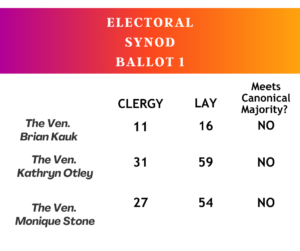
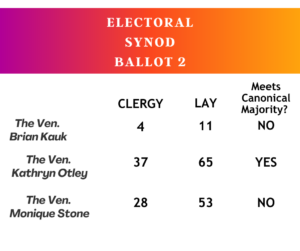
Voting is conducted by orders. In other words, the votes of clergy and laity are counted separately. To be elected, a nominee must receive a majority of votes both among the clergy and among the laity. If a round of balloting does not achieve this, more rounds of balloting follow until a nominee has achieved a majority in both houses.
Again, only persons entitled to vote in the Electoral Synod are entitled to nominate candidates for the office of Bishop.

8. What if I have more questions?
The Secretaries of Synod have a central role in administering the election process, and are the primary point of contact on questions of procedure. Please direct questions to them using the contact information below. They will be able to answer your questions, or direct you to someone who can.
Office of the Synod Secretaries
The Rev. Canon Stephen Silverthorne, Clerical Secretary
Margaret Porter, Lay Secretary
Synod-secretary@ottawa.anglican.ca
Tel. 613-836-1001


February 28, 2026

Electoral Synod

Archbishop Anne Germond, Metropolitan of the Ecclesiastic Province of Ontario, has summoned an Electoral Synod.

Details

The Synod will be held at Christ Church Cathedral, 414 Sparks Street, Ottawa.

Registration will begin at 8 am, followed by a 9 am celebration of the Eucharist.


Read her letter of summons

Shape of Parish Ministry

In 2020, our Diocese initiated the Shape of Parish Ministry consultation to discern how God is calling us to shape the future of parish ministry.

Read more

11 key actions

In 2023, a report was released, outlining 11 key actions to implement the proposals approved by Synod 2022. This report has since served as a foundational guide, providing clear, actionable steps.

Read more

Leadership Transition

Frequently Asked Questions

Download PDF


1.  Was Bishop Shane elected the new Primate of The Anglican Church of Canada?

Yes. Bishop Shane was elected Primate at the General Synod of The Anglican Church of Canada on Thursday, June 26, 2025. Bishop Shane was installed as Primate at St. Paul’s Cathedral in London, Ontario, on Sunday, June 29, 2025, and now has the title “Archbishop”.

2. Bishop Shane was not one of the four candidates for Primate. How did he end up being elected?

While the House of Bishops initially nominated a slate of four candidates, the House of Bishops can – if asked to by either the Order of Clergy or the Order of Laity — nominate new candidates during the electoral process for Primate. This is allowed under General Synod Canon III, which governs the election of the Primate. Bishop Shane was added to the nominees in this way and subsequently received the required number of votes from both the Orders of Clergy and Laity.

3. Is Archbishop Shane still the Bishop of Ottawa?

Yes. Archbishop Shane will remain Bishop of Ottawa until sometime in September 2025.

4. Can a Primate also hold the office of diocesan bishop?

Yes. Under the Canons of the General Synod of The Anglican Church of Canada, a new Primate may remain in their previous office of diocesan bishop for a period of 90 days after installation. This means that Archbishop Shane will remain Bishop of Ottawa until he chooses to resign that office sometime before Thursday, September 25, 2025.

5. What happens when Archbishop Shane resigns as Bishop of Ottawa?

Archbishop Shane’s resignation as Bishop of Ottawa will create a vacancy in the See. As a result, an Administrator will be appointed by the Diocesan Council under Canon 2.17 of the Canons of the Diocese of Ottawa to exercise the responsibilities of the Bishop until a new Bishop is elected.


6. Will there be an acting or interim diocesan bishop until a permanent bishop is in place?

No. An Administrator appointed by the Diocesan Council will exercise the responsibilities of the office of Bishop between the date of Archbishop Shane’s resignation and the election of a new Bishop. The Administrator—often (but not necessarily) a retired bishop or suffragan—exercises episcopal oversight temporarily, ensuring sacramental and pastoral continuity until a new diocesan bishop is elected and consecrated.

7. When will the Administrator be appointed?

Diocesan Council will likely appoint an Administrator some time before the date of Archbishop Shane’s resignation as Bishop of Ottawa.

8. When will a new Bishop be elected?

The new Bishop will be elected at an Electoral Synod presided over by Archbishop Anne Germond, Metropolitan of the Ecclesiastical Province of Ontario. She will likely announce the date of the Electoral Synod sometime this summer. The electoral process takes several months, meaning that the Electoral Synod will likely take place in early 2026.

9. Who is eligible to be a candidate in the episcopal election?

The rules governing the election of a new Bishop are set out in the Canons and Bylaws of the Dioceses of Ottawa, which can be found on the diocesan website. Once the Electoral Synod has been scheduled, the Secretaries of Synod will distribute further information regarding requirements and procedures relating to the Electoral Synod.

10. Could the Electoral Synod take place during this year’s Annual Diocesan Synod?

No – as there is insufficient time to follow and implement the canonical procedures as it pertains to an episcopal election.

11. Will the Anglican Diocese of Ottawa continue to operate as usual during the time of transition?

Yes, the Anglican Diocese of Ottawa will continue to operate as usual throughout the transition period leading up to the election of a new bishop. Ascension House remains operational, with staff working over the summer and available through the usual channels. As in previous years, appropriate measures are taken to ensure continuity of service during summer vacations and staff absences. While Archbishop Shane will continue in office as Bishop of Ottawa throughout the summer, he will be on vacation during the month of August 2025. During that time, Archdeacon Linda Hill will be exercising the Bishop’s responsibilities as the Episcopal Commissary.

12. What happens to current and existing episcopal panels and appointments? Do they immediately cease to exist?

Not necessarily. Committees, panels, and episcopal appointments—such as liturgical commissions, vocations panels, and pastoral appointments—typically remain in place. Many can continue under the authority of the Administrator until a new bishop reviews and reaffirms them.

13. Who will preside over the Annual Synod and will there be a Charge to the Synod in October 2025?

The Administrator will preside over the Annual Synod of the Diocese, which will take place from Thursday, October 23 to Saturday, October 25, 2025, as scheduled.

There will not be a traditional Charge to the Synod—which is typically a pastoral and visionary address delivered by the diocesan bishop—since the new bishop will not be in place by October 2025. Alternatively, the Administrator may offer a reflection, homily, or thematic address appropriate to the occasion and season of transition. In essence, while Synod will proceed as planned, its tone and leadership will reflect this interregnum period in the Diocese.


The Right Reverend Michael A. Bird served as the eleventh Bishop of the Anglican Diocese of Niagara, having been consecrated on September 30, 2007. During his episcopacy, he provided visionary leadership rooted in collaborative discernment, pastoral care, and a strong commitment to justice, inclusion, and the renewal of the Church’s mission in the world.
Ordained in 1984, Bishop Bird has over four decades of experience in ordained ministry. He served in five parishes across Newfoundland and Southern Ontario, holding leadership roles as Regional Dean and Archdeacon. Following his episcopal ministry, he was invited by the Rt. Rev. John Chapman, then Bishop of the Anglican Diocese of Ottawa, to serve as Incumbent of the newly formed Parish of the Valley, a regional ministry encompassing congregations in Whitney, Barry’s Bay, Killaloe, Eganville, Pembroke, and surrounding communities. He also served as Archdeacon of Pembroke and as Bishop’s Commissary during a medical leave period in the Diocese of Ottawa.
Now in semi-retirement, Bishop Bird continues to serve part-time in the Diocese of Ontario, ministering to congregations in Maynooth and Bancroft. He brings a theologically grounded and pastorally sensitive approach to ministry, with a focus on collaboration, faithful witness, and community engagement.
Internationally, Bishop Bird was actively involved in the Consultation of Anglican Bishops in Dialogue since its founding in 2011. His participation has included global conversations in Tanzania, South Africa, Ghana, Kenya, England, the United States, and through ongoing engagement with Niagara’s companion diocese in Cuba.
Bishop Bird holds a long-standing personal and spiritual connection to the Madawaska Valley, where he now resides on Lake Kamaniskeg with his wife Susan and their Old English Sheepdog, Abby. They enjoy time with their three adult children, their partners, and two grandchildren. His interests include jazz music, reading, hiking, skiing, snowshoeing, boating, and travel.

Read full PDF here.

Who is the Administrator of the Diocese?
On August 6, 2025, the Diocesan Council appointed the Right Reverend Michael Bird as the Administrator of the Diocese. His mandate came into effect on September 21, 2025, ensuring the effective governance and continuity of leadership within the Anglican Diocese of Ottawa during this period of transition without an elected bishop for our diocese.
Bishop Michael is a retired Bishop of the Diocese of Niagara (2008-2018) and has been resident in our Diocese since 2018. His biography can be found here. Bishop Michael’s term as Administrator of the Diocese ends upon the installation of the next Bishop of Ottawa. This means that Bishop Michael will be the Administrator throughout the episcopal election process, the election day being February 28, 2026, and will remain in office until the ceremony of installation and consecration of the new Bishop, which is scheduled to take place at Christ Church Cathedral in Ottawa on May 9, 2026.

What is the Administrator of the Diocese?
The Administrator is an individual appointed by Diocesan Council, pursuant to Canon 2.17, to exercise the duties and responsibilities of the Bishop of Ottawa in the event of a “vacancy in the See” caused by, among other things, the resignation of the Bishop. Under the Canons, the Administrator has “all the powers of the Bishop of the Diocese”. In other words, while the Administrator is not the Bishop of Ottawa, he can exercise all the rights and function conferred on the Bishop under the Canons, Bylaws and Regulations of the Diocese of Ottawa.

How does the work of a Diocesan Administrator differ from that of a Diocesan Bishop?
Most of the authority and the responsibilities of a Diocesan Bishop are conferred upon the Administrator so that the ongoing day to day work of our diocese can continue without interruption. As a rule, the Administrator would not authorize any new policies, administer the sacrament of ordination or institute any changes to the overall direction of our work in particular ministries. Decisions of this kind will generally be left to the incoming bishop. Our retired bishops, Bishop John Chapman and Bishop Peter Coffin, have graciously agreed to cover any confirmations that were scheduled during this interim period.

Why is there an Administrator of the Diocese?
When Archbishop Shane was elected Primate of Canada on June 26, 2025, he was required to resign as Bishop of Ottawa within 90 days his election. Archbishop Shane resigned as Bishop of Ottawa on September 20, 2025, thus creating a vacancy in the See. On August 6, 2025, in anticipation of Archbishop Shane’s resignation, the Diocesan Council appointed the Bishop Michael as Administrator of the Diocese to take effect on September 21, 2025.

Download PFD here.

Ottawa Anglican Diocese icon

Canons And Bylaws

Concerning The Election Of A Bishop